Grinding wheels are indispensable tools in industrial production, finding wide application in mechanical processing, shipbuilding, rail transport, and other key industries. Their safety is directly related to the personal safety of operators and production efficiency. In recent years, rapid development in global manufacturing has led to frequent safety accidents involving grinding wheels. This has prompted countries worldwide to tighten regulations and supervision regarding the safety performance of grinding wheel products.
However, differences in safety standards across various countries and regions pose challenges for international trade and safety management. The objective of this study is to comprehensively investigate and compare the differences in grinding wheel safety standards in major countries and regions such as China, Europe, the USA, Japan, and South Korea.
In doing so, particular attention is paid to the Japanese safety requirements regarding the bursting behavior of grinding wheels. The study also analyzes the technical reasons and safety concepts behind these differences and incorporates practical performance data from FUJI Grinding Wheel as references for manufacturers, users, and relevant regulatory authorities. The ultimate goal is to facilitate the improvement of global grinding wheel safety performance and the coordination of standards.
FUJI Grinding Wheel not only strictly adheres to JIS standards and traditional craftsmanship during production but also regularly exceeds them. Rigorous safety tests demonstrate that 4-inch FUJI Super F2 grinding wheels exhibit exceptional safety reserves, reliably withstanding loads equivalent to double the specified operating speed and maintaining structural integrity even at extreme speeds such as 30,000 RPM.
2. Overview of Safety Standards for Grinding Wheels in Major Countries/Regions
2.1 China’s Grinding Wheel Safety Standard System
China’s safety standards for grinding wheels consist of national standards and industry standards. The core is GB 2494-2014 "Safety Requirements for Bonded Abrasives", the only mandatory national standard in the abrasive tool industry. This standard specifies the rotational strength requirements for abrasive tools (excluding mounted points), including safety speed and burst speed requirements. Different safety factors apply to various machine types, tool types, and maximum operating speeds. Specifically, the burst safety factor for grinding wheels is set at 1.73, meaning the actual burst speed of the grinding wheel must be at least 1.73 times its specified maximum operating peripheral speed.
Additionally, China has supporting standards such as GB 4674-2009 "Safety Code for Grinding Machines", which details the installation, use, and maintenance of grinding wheels. The newly revised 2025 standard GB2025.3-2025/IE 20255-2-3:2025 also clarifies that the arbor hole dimensions of grinding wheels, flanges, backing pads, or other accessories must be suitable for installation on the spindle of power tools, and mandates that tools must be designed to prevent overspeeding during normal use.
2.2 European Grinding Wheel Safety Standard System
European safety standards for grinding wheels are primarily developed by the European Committee for Standardization (CEN). The key standard is EN 12413:2019 "Safety Requirements for Bonded Abrasive Products", which establishes safety requirements for bonded abrasives, including general requirements, strength requirements, dimensional requirements, permissible unbalance, and marking. Consistent with Chinese standards, the burst safety factor for European grinding wheels is 1.73, ensuring the product's burst speed exceeds 1.73 times the maximum operating speed.
The European standard system also includes EN 13743:2017 "Safety Requirements for Coated Abrasives" and EN 13236:2019 "Safety Requirements for Superabrasive Products", creating a complete set of safety standards for abrasive tools. Furthermore, grinding machines in Europe are classified into three risk levels (Class A/B/C), requiring manufacturers to select appropriate safety measures based on equipment type, such as strength calculations for grinding wheel burst guards, design of isolation devices for moving parts, and response time requirements for emergency stop functions (typically ≤ 0.5 seconds).
2.3 US Grinding Wheel Safety Standard System
US safety standards for grinding wheels are primarily developed by the American National Standards Institute (ANSI) and the United States Abrasive Manufacturers Association (US-UAMA). ANSI/UAMA B74.12-2018 is a standard specifying abrasive grain sizes for grinding wheels, polishing, and general purposes. A notable difference from Chinese and European standards is that the burst safety factor for US grinding wheels is 1.5, which is lower than the 1.73 value in China and Europe. US standards are technically very detailed but relatively broad in scope, differing significantly from the Chinese standard system. For example, ANSI B7.1 requires residual stress measurement of metal-bonded grinding wheels using X-ray diffraction with a detection accuracy better than ±15 MPa.
2.4 Japanese Grinding Wheel Safety Standard System
Safety standards for grinding wheels in Japan are primarily developed by the Japanese Industrial Standards Committee (JISC). JIS R 6242:2015 is the core standard for bonded abrasives. Japan’s safety standard for grinding wheel bursting is the strictest among major economies. Specifically, the burst performance requirement for Japanese grinding wheels mandates that the product must not burst when subjected to a peripheral speed that is double (2x) its specified operating peripheral speed. This is significantly higher than the burst safety factor of 1.73 in China and Europe and 1.5 in the USA, reflecting Japan’s extremely high safety threshold for grinding wheel products.
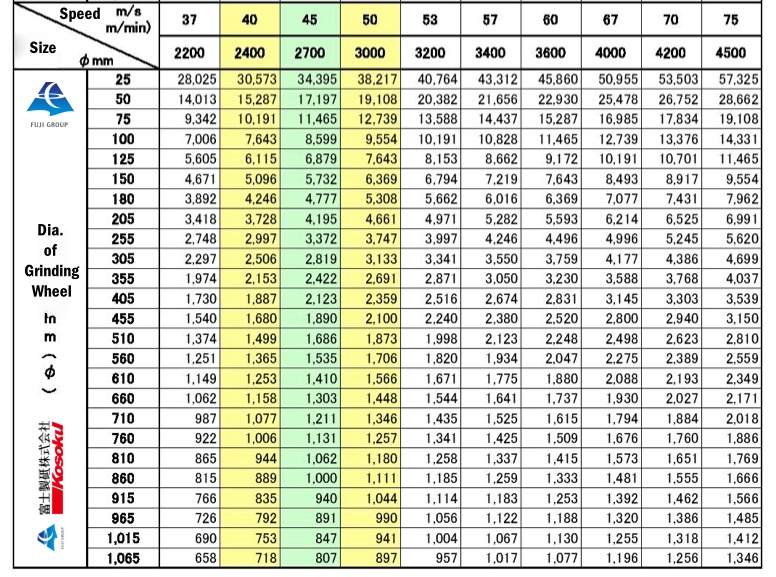
Relationship between Wheel Diameter and Safe Operating Speed.
2.5 South Korean Grinding Wheel Safety Standard System
South Korean safety standards for grinding wheels are primarily developed by the Korean Agency for Technology and Standards (KR-KATS). These include standards such as KS L ISO 603-6:2014 "Bonded Abrasives – Dimensions – Part 6: Grinding Wheels for Tool and Cutter Grinding". South Korea’s Industrial Safety and Health Act (ISHA) mandates that certain high-risk mechanical equipment must obtain KCS certification before it can be sold and used in the Korean market.
3. Comparison of Key Indicators in Global Safety Standards for Grinding Wheels
3.1 Comparison of Burst Safety Factor Requirements
The burst safety factor is a central indicator of grinding wheel safety, indicating the safety margin of the wheel at maximum operating speed. There are significant differences between countries regarding this requirement:
Region / Standard
Safety Factor
Example Burst Threshold (for 80m/s Wheel)
China (GB 2494-2014)
1.73x
138.4 m/s
Europe (EN 12413:2019)
1.73x
138.4 m/s
USA (ANSI B7.1)
1.5x
120 m/s
Japan (JIS R 6242)
2.0x (Strictest)
160 m/s
South Korea (KCS)
LCA Focus
References International Standards
Video: FUJI 4" Super F2 Grinding Disc surviving a 30,000 RPM destructive test.
3.2 Comparison of Guard Requirements
Grinding wheel guards are critical safety devices to prevent injuries from flying debris in the event of a wheel burst. Standards for guards vary by country:
China: For grinding machines with a rated grinding capacity of 55 mm or more, only one rated speed may be specified. Guards must prevent operator injury.
Type 1, 41, 42: Guards must cover at least 175° of the wheel circumference and both sides.
Type 27, 28, 29: Guards must cover at least 175° and feature a 3 mm wide front lip extending radially from the inner face.
Type 6 and 11: Guards must cover at least 240° and be continuously adjustable to compensate for wheel wear.
Europe (EN ISO 16089:2025): Grinding machines are classified into three risk levels (A/B/C). Manufacturers must select appropriate safety measures based on equipment type, including strength calculations for burst guards. The standard also sets noise protection requirements: the sound pressure level at idle must not exceed 85 dB(A).
United States (ANSI B7.1): Emphasizes operator safety measures, such as requiring appropriate safety guards near grinding wheels to prevent injury from flying debris.
Japan: The strictest requirement globally, with a 2x burst performance standard. Japanese standards also emphasize the durability and impact resistance of guards, requiring them to maintain structural integrity even under extreme conditions like a wheel burst.
South Korea: Grinding machines must comply with South Korean noise control standards during operation. The design and manufacture of grinding equipment must comply with electrical safety specifications (cable insulation, short-circuit protection) to prevent safety accidents caused by power failures.
3.3 Comparison of Unbalance Requirements
The unbalance of a grinding wheel is a crucial factor for stability and safety. Standards for unbalance vary by region:
China (GB 2494-2014): Clearly states that grinding wheel unbalance must be controlled within a specified range to prevent excessive vibration and noise during high-speed rotation, which could compromise grinding performance and safety.
Europe (EN 12413:2019): Sets unbalance requirements with reference to international standards, which have also been adopted into Chinese national standards.
United States (ANSI/UAMA B74.22-1991(R2014)): A standard for the design and testing of Type 27 portable grinding wheels covering key contexts from material selection to end-product performance evaluation, including test methods for wheel strength, balancing requirements, and rotational stability indicators.
International Standard (ISO 21940-11:2016): Developed by the ISO for balancing rigid rotors. The standard divides rotors into 16 balance quality grades. For example, Grade G6.3 is typically used for general motors, pumps, and fans (shaft height ≥ 80 mm).
3.4 Comparison of Marking and Traceability Requirements
Grinding wheel marking is essential for conveying product information, ensuring proper use, and guaranteeing traceability.
China: Requires clear indication of traceability codes, manufacturer information, product specifications and models, abrasive type, grit size, hardness grade, and bond type. Accuracy is crucial to prevent consumer misuse.
Europe (EN 12413:2019): Emphasizes the importance of marking, requiring abrasive products to display clearly visible safety warnings and instructions. Safety symbols must comply with EN ISO 7010.
United States (ANSI/UAMA B74.12-2018): Details requirements for abrasive grain size for various application scenarios. It covers various abrasive types like aluminum oxide, silicon carbide, and other synthetic materials.
Japan: Sets stricter requirements for protective materials for grinding wheels and mounting shafts. Japanese standards also require detailed marking of product safety performance indicators, such as maximum operating speed and burst speed ratio, to ensure transparency for users.
South Korea: Introduces stricter requirements for traceability. KATS Regulation No. 2023046 includes a Life Cycle Assessment (LCA) mechanism mandating carbon footprint reports for high-end grinding wheel products.
3.5 Comparison of Test Methods and Certification Requirements
Differences in test methods and certification requirements directly impact the quality and safety of grinding wheels:
China: Grinding wheel testing includes laboratory tests and on-site tests. Institutions conducting tests must hold CMA (China Inspection Body and Laboratory Mandatory Approval) and CNAS (China National Accreditation Service) qualifications.
Europe: Institutions conducting tests according to EU standards must also hold CMA and CNAS qualifications. For precision grinding machines, the technical documentation for CE certification must include a risk assessment report (EN ISO 12100) and noise test reports (EN ISO 4871).
USA: Requires testing by OSHA-approved laboratories. Specific methods include X-ray diffraction for residual stress (±15 MPa).
Japan (JIS Certification): Strict tests according to JIS B 4053 (e.g., durability during high-speed rotation). JIS certification includes grades for production quality control.
South Korea (KCS Certification): Testing according to KOSHA standards by designated Korean laboratories is mandatory for market access.
4. Main Reasons for Differences in Global Standards
4.1 Safety Philosophy and Technical Approach
China: Focuses on "operator safety," emphasizes basic compliance, combines mandatory and voluntary standards, and aligns with international norms.
Europe: Based on "Risk Management." Tailors safety measures to risks (A/B/C), values systemic safety (guards, emergency stops), balances safety and productivity.
USA: Emphasizes "Practicality and Operability." Standards describe specific test methods but have lower safety factor thresholds adapted to the local manufacturing pace.
Japan: Philosophy of "Ultimate Safety." Extreme requirements (Factor 2.0, durability tests) maximize safety margins and reflect the goal of "Zero Accidents."
South Korea: "Safety and Environmental Protection." Combines basic safety with mandates for eco-friendly manufacturing (LCA, Carbon Footprint).
4.2 Industry Needs and Market Environment
In China and Europe, the large, diverse manufacturing base requires a standard (1.73) that balances "universality" and "specialization," ensuring a balance between cost and safety. In the USA, the focus is on high-end equipment; standards prioritize "ease of operation," accepting a lower safety factor (1.5) in favor of productivity. In Japan, high-precision manufacturing means wheel failure carries the risk of costly damage; Factor 2.0 mitigates this risk. South Korea's export-oriented economy blends international alignment (EN/ISO) with national environmental policy.
4.3 Certification and Regulatory Systems
China and Europe rely on "Mandatory Standards + Third-Party Certification" (CCC, CE), covering production, sales, and use. The USA uses an "OSHA Supervision + Laboratory Certification" model, focusing on usage safety with less intervention in production. Japan's JIS certification is often voluntary but treated by high-end manufacturers like FUJI as a market requirement ("market-driven conformity"). South Korea uses KCS certification as a mandatory market access threshold for high-risk equipment, combined with environmental regulations.
5. Conclusions and Recommendations
5.1 Key Conclusions
Burst Factor is the Main Differentiator: Japan (2.0) > China/Europe (1.73) > USA (1.5). The Japanese standard is the strictest worldwide.
Performance Varies: Manufacturers like FUJI exceed their national standard (JIS), while some international brands may not meet their stated standards.
Philosophy Drives Standards: Different core philosophies ("Basic Safety," "Risk Balance," "Practical Efficiency," "Ultimate Safety," "Safety+Eco") adapt to local needs.
Regulatory Impact on Enforcement: China/Europe (mandatory certification), Japan (market-driven), and South Korea (dual regulation) have strong enforcement power; the USA focuses more on end-use.
5.2 Recommendations for Manufacturers
Market-Specific Compliance: Aim for JIS F4 certification for Japan (Factor 2.0), CE/CCC for EU/China (Factor 1.73), OSHA approval for the USA (Focus on residual stress).
Benchmark against Japanese Standards: Emulate FUJI's "beyond the standard" design for precision applications. Offer tiered product lines (e.g., 1.73 Basic / 2.0 Premium).
Strengthen Supply Chain and Testing: Implement traceability for raw materials (abrasives, binders). Invest in testing equipment (X-ray stress, high-speed test benches) to ensure performance matches markings.
Improve Marking and Documentation: Clearly mark key specifications for each target market (e.g., "Withstands 2x speed" for Japan). Provide installation/maintenance manuals tailored to different standards.
5.3 Recommendations for Users
Select Compliant Products: For precision grinding (Electronics), prioritize JIS-certified or higher-performance products (e.g., FUJI). For general purpose, China/EU standard products are sufficient.
Follow Safety Regulations: Never exceed the specified speed. Regularly check balance (within G6.3). Inspect guards weekly for gaps (≤10 mm) and damage.
Implement Lifecycle Management: Track procurement (request certificates), usage (operating hours, speed), and disposal. For imported wheels, consider having key specifications verified by third parties (CMA/CNAS labs).
Provide Safety Training: Train operators on the differences between standards (e.g., US barrier requirements). Provide appropriate personal protective equipment (e.g., hearing protection for EU noise limits).
5.4 Recommendations for Regulators
Promote Standard Harmonization and Updating: Lead or participate in initiatives for an "Asian Grinding Wheel Safety Standard Alliance," potentially adopting Factor 2.0 as a premium benchmark. Revise GB 2494 to include high-speed stability tests.
Strengthen Market Access and Market Surveillance: Include testing of actual burst speed in CCC certification. Conduct unannounced spot checks on imported wheels (especially with EN/ANSI markings) and publicize non-compliant brands. Create a "Safety Blacklist."
Improve Certification and Testing Infrastructure: Support domestic labs in obtaining OSHA/JIS accreditation to reduce export testing costs. Establish regional public testing platforms in industrial hubs offering cost-effective burst speed/residual stress tests.
Promote International Cooperation and Risk Awareness: Conclude mutual recognition agreements with JISC, CEN, etc. Publish global accident case studies to raise awareness for products with high safety margins.
Experience the Ultimate Safety Standard
The complex landscape of global safety standards for grinding wheels is critical for ensuring operational safety. While the Japanese JIS standard sets the highest benchmark with its burst factor of 2.0, true excellence lies in consistently exceeding these requirements. FUJI Grinding Wheel exemplifies this principle. We invite manufacturers and users to uphold the highest quality standards to ensure the best possible protection worldwide.