Angle grinders are essential in shipbuilding, steel fabrication, foundries and industrial maintenance. Managing hand-arm vibration exposure means considering the grinder, handle, abrasive and working method together. A comfortable tool setup is valuable, but daily exposure also depends on vibration magnitude and the time the tool is actually used.
This guide explains practical controls using Japanese Ministry of Health, Labour and Welfare (MHLW) guidance and UK Health and Safety Executive (HSE) guidance, alongside FUJI and KOSOKU equipment-selection considerations.
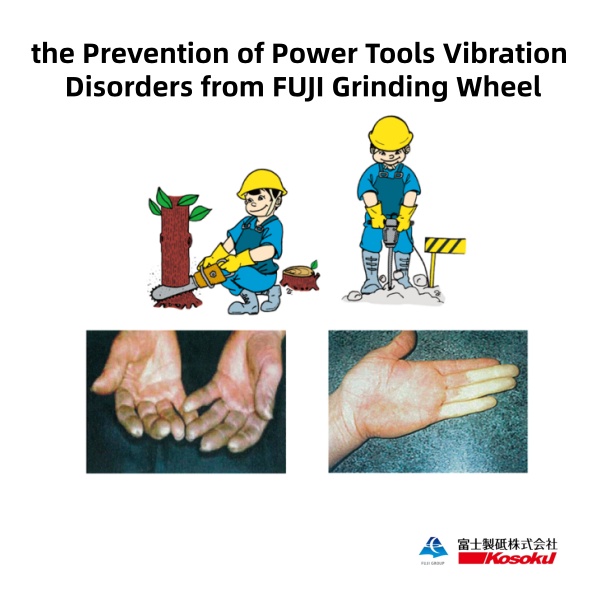
Repeated exposure to hand-transmitted vibration can damage blood vessels, nerves and other tissues in the hands and arms. Symptoms may include tingling, numbness, reduced dexterity and finger blanching, sometimes called vibration white finger. Damage can become permanent. Workers who develop symptoms should report them promptly and seek occupational-health assessment.
Risk depends on exposure magnitude, duration and individual factors. Tool selection, working methods and early health surveillance are complementary parts of prevention; no grinder or accessory alone guarantees protection.
Japan’s MHLW guidance for vibrating tools other than chainsaws uses the daily vibration exposure value A(8), combining frequency-weighted three-axis vibration acceleration with exposure time. It identifies an action value of 2.5 m/s² A(8) and a limit value of 5.0 m/s² A(8).
The UK has the same numerical values under its workplace vibration framework. HSE explains the associated employer duties in its exposure action and limit value guidance. These are jurisdiction-specific requirements, not universal product certifications or guarantees of risk-free operation below the action value.
The existing preventing vibration disorders resource is retained for reference. Use the official guidance applicable to your location when planning controls.
For one tool or task: A(8) = ahv × √(T/8), where ahv is the frequency-weighted three-axis vibration total value in m/s² and T is actual daily exposure time in hours. Include all vibrating tools used during the day in a combined assessment.
For example, 5 m/s² for two hours gives A(8) = 2.5 m/s². This is an illustrative calculation, not a FUJI product rating or recommended working allowance. Breaks do not erase exposure already accumulated. HSE’s vibration risk assessment guidance explains representative data and trigger-time estimates.
The FUJI anti-vibration grinder handle is an equipment option designed to help reduce vibration transmitted through the auxiliary grip and support controlled handling. Confirm compatibility and install it according to the manufacturer’s instructions. Assess its contribution with the actual grinder and task.
Specialist anti-vibration gloves may attenuate vibration in particular frequency ranges and operating conditions. Their performance depends on the glove, tool, grip and task. Select them using relevant test evidence for the intended combination; certification alone does not demonstrate effective reduction for every grinder.
HSE cautions against relying on gloves as the primary vibration control. Its hand-arm vibration guidance, L140 discusses the need for evidence of reduction for the particular glove and machine. Separately, suitable clothing and gloves can help keep workers warm and dry; this is distinct from vibration attenuation.
Train operators to recognize symptoms, report changes and follow the planned controls. Provide health surveillance where the risk assessment and local requirements call for it. HSE’s worker protection guidance covers equipment selection, work organization and health surveillance.
FUJI’s approach is to consider cutting performance and handling together. A suitable grinder, anti-vibration handle and matched abrasive can improve control and reduce unnecessary operator effort. Effective material removal may also shorten the time needed for a defined job; verify the overall exposure benefit using representative vibration and operating-time data.

KOSOKU high-frequency grinders use brushless squirrel-cage asynchronous induction motors. They have no carbon brushes or commutators, while retaining a rotating rotor. This construction removes brush-servicing requirements and supports industrial grinding applications with a matched high-frequency supply.
Stable operation, appropriate power and well-maintained components contribute to effective grinding. They do not establish that every high-frequency grinder has lower vibration in every task. Assess the model with its chosen abrasive, workpiece and operating conditions.
FUJI Grinding Wheel develops abrasive wheels and grinding equipment, enabling the consumable and machine to be considered as a system. Selected flexible wheels and warm-press formulations are designed to balance cutting action, wear and grinding feel.
A suitable flexible wheel can help the operator maintain controlled contact without unnecessary force. The resulting vibration depends on more than flexibility: abrasive grade, wheel condition, mounting, grinder speed and the contact area all matter. Do not assume all FUJI wheel series share the same flexibility or vibration performance.
Match the wheel to a compatible KOSOKU high-frequency grinder and, where suitable, a anti-vibration grinder handle. Evaluate the combination on the intended workpiece, comparing task time, vibration and finished quality. Lower effort or less visible chatter is useful feedback, but is not a substitute for exposure assessment.

For one task, A(8) = a_hv × √(T/8), where a_hv is the frequency-weighted three-axis vibration total value in m/s² and T is the actual daily exposure time in hours. For multiple tasks, A(8) = √[Σ(a_hv,i² × T_i)/8]. Use representative vibration data and actual trigger times; do not simply add acceleration values.
A suitable high-frequency grinder can support stable operation and efficient task completion. Its brushless squirrel-cage induction motor does not require carbon-brush maintenance. The reduction in vibration exposure depends on the complete tool, wheel, workpiece and operating time, so compare representative task data rather than assuming every high-frequency tool has lower vibration.
Yes. Wheel condition, balance, mounting, abrasive selection and contact with the workpiece can affect vibration and handling. A suitably selected FUJI flexible grinding wheel can support smoother contact and controlled grinding. Choose it for the material and task, and assess the combined system under actual conditions.
Some anti-vibration gloves can attenuate vibration under particular conditions. Use relevant test data for the glove and tool combination, and check that fit and grip remain suitable. Gloves are supplementary measures; they do not guarantee prevention of HAVS or replace exposure control.
No. An action value is a management threshold, not a guarantee that no worker can be affected. Reduce exposure where reasonably practicable and follow applicable local requirements, including health surveillance where indicated.
Provide the grinder model, wheel specification, workpiece material, task, current vibration information and daily trigger time. Discuss a matched grinder, handle and abrasive, then compare performance and exposure using the same job and quality requirements.
Explore fujigrindingwheel.com and the FUJI product catalogs for equipment and consumable options. Send your workpiece material, grinding task, current tool and wheel, operating time and the improvement required. FUJI can help with application selection; workplace vibration assessment should use representative data and applicable local requirements.


