Engineered for Heavy Industry: Redefining Continuous Operation Standards
In high-wage industrial regions across Europe and North America, plant managers face a universal challenge: the hidden cost of inefficient labor. When surface preparation, weld blending, or heavy foundry grinding becomes a bottleneck, the immediate reaction is often to add more manpower. However, equipping highly paid workers with underperforming pneumatic or standard AC tools is an expensive miscalculation.
To address the rigorous demands of continuous, heavy-duty metal surface treatment, Fuji Grinding Wheel Mfg. Co., Ltd. presents the official performance standards and field test data for our industrial-grade tools. Manufactured in Japan to strict JIS standards, our high-frequency grinders are engineered for the most extreme industrial environments. Supported by our European service center in Budapest, we ensure localized technical support to keep your production lines moving.
To truly understand the performance capabilities of our modern equipment, one must look at the heritage of Kosoku (Fuji Grinding Wheel's power tool division). For decades, the Japanese heavy industry sector has relied heavily on ultra-stable 250Hz high-frequency technology. This 250Hz brushless ecosystem has been the undisputed backbone of Japanese shipyards and foundries, renowned for its indestructible nature and consistent torque under severe pressure.
While 250Hz remains the mature, dominant standard within Japan's domestic market, the global export market demands even higher rotational speeds and extreme output ratios to maximize modern abrasive efficiency. Answering this call, Fuji engineered the 300Hz series. The 300Hz machines, such as the HGC-3902, are a direct, powerful evolution upgraded from our heavily proven 250Hz architecture. By increasing the frequency to 300Hz, we unlocked higher RPMs and unprecedented power density, delivering a globally optimized tool that retains the legendary durability of its Japanese 250Hz predecessors.
Figure 1: The HGC-3902 300Hz HF Grinder tackling heavy slag removal in a foundry environment.
Before deploying these tools to the field, they must pass our rigorous internal engineering benchmarks. Under optimized laboratory conditions (ambient temperature of 25°C in a completely dust-free environment), our 300Hz high-frequency grinders achieve an operational lifespan exceeding 300 hours when adhering to our strict cyclical protocol.
Managing these extreme thermal loads during high-frequency cycles requires superior engineering. This equipment utilizes an advanced forced-air cooling mechanism. A high-speed rotating fan mounted directly on the rotor generates a powerful, high-velocity airflow. This system continuously draws ambient cold air through the rear intake of the motor chamber, forcing it across the highly conductive surfaces of the stator and rotor to efficiently dissipate core thermal energy. The residual hot air is then forced forward and expelled through the front exhaust ventilation ports, keeping the operator safe and the motor within operational limits.
Laboratory performance claims mean nothing without empirical field data. To provide transparent, authoritative data for industrial procurement, our engineering team conducted a rigorous continuous 4-hour material removal test on standardized cast iron workpieces under controlled foundry conditions. We evaluated the Fuji HGC-3902 High-Frequency Grinder directly against industrial-grade pneumatic angle grinders and standard AC electric grinders.
| KEY METRICS | FUJI HGC-3902 HF GRINDER (300HZ) | PNEUMATIC ANGLE GRINDER (AIR) | STANDARD AC ANGLE GRINDER |
|---|---|---|---|
| Material Removal Rate (4-Hour Test) | 2002g (Highest removal rate) | ~550g (Lowest removal rate) | 700g (Medium-low rate) |
| Output Power & Speed Under Load | Constant High Power (No speed drop) | Inconsistent (Drops significantly) | Poor (Power drops rapidly; frequent stops) |
| Power / Energy Cost | Low (Highly efficient 3-phase) | High (5x higher than electric due to compressor) | Low |
| Time & Labor Costs | Lowest (1 operator does the work of 4) | High (Longer time per workpiece) | Highest (Inefficient work pace) |
"Based on the 4-hour field test, the math is undeniable: 1 FUJI HF Grinder = 4 Pneumatic Grinders = 3 Regular AC Grinders in terms of raw output. In high-wage regions like Europe and the US, equipping a worker with an underperforming tool is the most expensive mistake a plant manager can make."
— Mr. Zhong, Chief Technical Engineer, FUJI Grinding Wheel
The staggering 2002g material removal rate (MRR) of the Fuji HGC-3902—compared to a mere 550g for pneumatic and 700g for AC tools—is not magic; it is pure physics and advanced engineering.
When an operator presses a standard AC grinder or an air grinder hard against cast iron, the RPM plummets. This loss of speed drastically reduces the abrasives' cutting ability. The HGC-3902 features a brushless, 3-phase squirrel-cage motor. Due to the high-frequency 300Hz power supply, it maintains an almost flat torque curve. Even when pushed to a 150% temporary overload, the RPM remains constant, allowing the abrasive grains to fracture and cut at their optimal designed speed.
Many foundries default to pneumatic tools for safety and weight. However, air is a highly inefficient power transmission medium. Generating compressed air requires massive electrical input at the compressor station. As noted in our metrics, the energy cost of running air tools is up to 5 times higher than the direct 3-phase electrical efficiency of our HF system.
Standard AC grinders rely on commutators and carbon brushes, which burn out rapidly in dusty foundry environments, leading to extreme maintenance costs and daily downtime. Evolved from our Kosoku blueprint, the 300Hz motor has no wearing electrical parts (no brushes). To guarantee optimal mechanical efficiency, structural integrity, and operational safety, we strongly recommend the following preventative maintenance intervals for the mechanical consumable components:
| Component Name | Reference Replacement Interval | Operational Notes |
|---|---|---|
| Bearings | 600-1,000 Hours | Replace once within this cumulative operational window to prevent rotor imbalance. |
| Gears | 300-400 Hours | Replace once within this window to maintain accurate torque transmission and minimize wear. |
| Lubricating Grease | 150-200 Hours | Complete grease replacement required to ensure proper thermal dissipation inside the gearbox. (Mid-point maintenance is strictly advised at 150 hours). |
Watch how the constant RPM of the HGC-3902 slices through heavy welding seams without stalling, proving the theoretical continuous operation capacity in a real-world environment.
A high-frequency grinder is only as good as the abrasive it spins. Because the HGC-3902 does not lose RPM under pressure, it perfectly complements advanced, aggressive abrasives that require high heat and high pressure to self-sharpen.
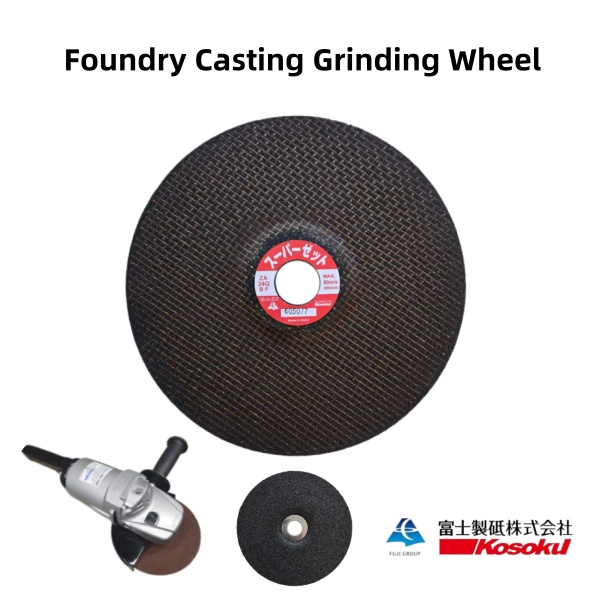
To maximize the 2002g material removal rate, we strongly recommend pairing this tool with our specialized Zirconia Alumina Grinding Wheels specifically designed for cast iron. Zirconia grains are exceptionally tough; on standard tools, they often glaze over because the tool bogs down. On a Fuji 300Hz grinder, the relentless speed forces the Zirconia grains to micro-fracture continuously, exposing fresh, razor-sharp edges to the metal, further slashing your labor times.
Historically, Japanese heavy industries exclusively use the ultra-reliable 240/250Hz standard. The 300Hz models, like the HGC-3902, are an advanced evolution of our 250Hz technology, engineered specifically to meet the higher RPM and aggressive output demands of the global export market.
Yes. You must use a dedicated high-frequency converter (inverter) to safely convert standard 50Hz/60Hz grid power into the 300Hz 3-phase power required by the grinder's brushless motor.
Thanks to its brushless design, daily electrical maintenance (like changing carbon brushes) is completely eliminated. For mechanical components, we mandate a full gearbox lubricating grease replacement at 150-200 hours, and gear inspections every 300-400 hours of continuous operation.
Ready to see how 1 Fuji HF Grinder can replace 4 pneumatic tools in your facility? Contact our European or Global sales team to request a Prototype Trial Machine for an on-site evaluation.
Contact Us / Request a Demo


