In the highly competitive sectors of heavy-duty industrial manufacturing, foundry operations, and structural steelworks, abrasive efficiency directly impacts the bottom line. For decades, operators have struggled with standard grinders that bog down under pressure, overheating motors, and frequent maintenance breaks. The solution to these bottlenecks lies in advanced high frequency grinders.
A benchmark in this category is the 4-inch (100mm) Portable High Frequency Angle Grinder (HGC-250Ⅱ) engineered by Fuji Grinding Wheel. Built for continuous industrial use, this tool leverages advanced 3-phase power technology to guarantee zero speed variance under heavy load. When you press the abrasive disc against a weld seam, the HGC-250Ⅱ refuses to slow down, drastically increasing material removal rates while protecting operator ergonomics.
Traditional universal motor grinders experience a severe drop in RPMs the moment you apply grinding pressure. This not only slows down fabrication but also accelerates the wear and tear on the abrasive disc itself. The HGC-250Ⅱ overcomes this through its internal architecture.
By utilizing a Frequency Converter (stepping up standard 50/60Hz power to 240Hz/250Hz), the motor can be constructed significantly smaller and lighter while delivering exponentially higher torque. The heart of the machine is a three-phase squirrel cage induction motor. Because it operates at a high frequency, the grinder maintains a relentless rotational speed of 9,000 min⁻¹ regardless of how aggressively the operator pushes.
Facility managers and procurement teams often weigh different power tool ecosystems. Here is a technical breakdown of why upgrading to a high frequency system yields a higher long-term Return on Investment (ROI):
| Performance Metric | Fuji HGC-250Ⅱ (High Frequency) | Standard Electric Grinder | Industrial Pneumatic Grinder |
|---|---|---|---|
| Speed Stability (Under Load) | Exceptional (100% Constant) | Poor (Significant RPM drop) | Moderate (Relies on air pressure) |
| Motor Maintenance | Virtually Zero (Brushless) | High (Frequent brush replacements) | Moderate (Vanes wear, requires oiling) |
| Energy Efficiency | High (Direct power conversion) | Medium | Low (Air compressors consume high power) |
| Ergonomics & Handling | Lightweight & Balanced | Heavy & Bulky | Light tool, but drag from heavy air hoses |
Investing in reliable, high-end tools is a strategic move. While the initial setup requires a frequency converter, the operational cost plummets over time. In shipyards, automotive manufacturing, and structural steel plants, replacing standard tools with models from a dedicated high frequency grinder manufacturer minimizes costly downtime and dramatically speeds up project turnaround times.
High frequency grinders use a 3-phase induction motor which maintains constant speed even under heavy load, preventing the RPM drop common in standard tools. This results in significantly higher productivity, deeper material removal, and a longer tool lifespan.
No. The HGC-250II utilizes a brushless squirrel cage induction motor design. This significantly reduces maintenance costs and downtime since there are no carbon brushes or commutators to wear out or replace, making the tool much more durable in heavy-duty environments.
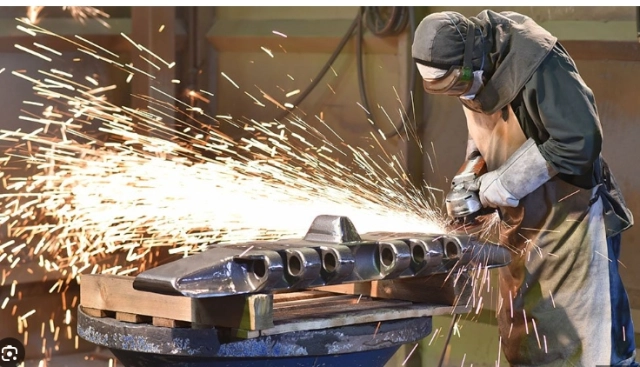
Thanks to its exceptional power-to-weight ratio and constant speed under load, it is perfectly suited for foundry casting finishing, heavy weld seam removal, continuous sheet metal fabrication, and shipyard metalworking where standard grinders would lose efficiency or overheat.
Yes, high frequency grinders require a frequency converter to step up the standard mains power (50/60Hz) to the required high frequency (240Hz-400Hz). This converter protects the tool, ensures stable 3-phase power output, and maximizes grinding efficiency.