

In the high-stakes world of metal fabrication, shipbuilding, and industrial pipe fitting, the difference between a clean, efficient cut and a catastrophic wheel failure often lies in the manufacturing heritage of your abrasives. While standard cut off wheels are viewed as simple consumables, B2B procurement teams and facility safety managers know that profound engineering is required to produce a safe, high-performance tool.
This comprehensive technical guide explores the metallurgy and chemistry behind the FUJI cut off wheel. Whether your operation requires a standard 4-inch to 7-inch angle grinder cutting disc or a heavy-duty large resin cutting wheel for stationary chop saws, understanding the "Original Japanese Process" will help you optimize your production workflow, minimize your Heat Affected Zone (HAZ), and drastically reduce total operational costs.
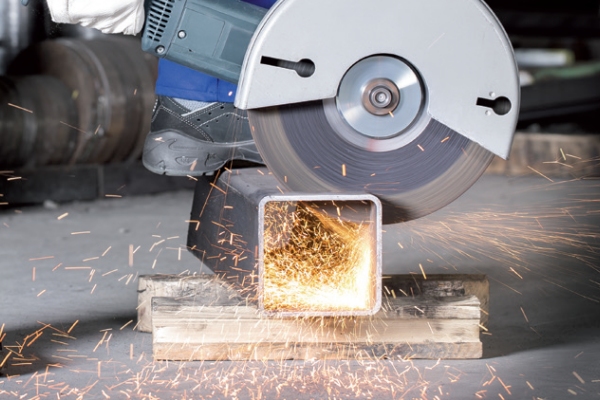 Figure 1: High-precision, burr-free cutting on structural steel using FUJI Japanese abrasive technology.
The "Japan Cutting Disc" Advantage: Phenolic Resins & Structural Integrity
What mathematically separates a genuine Japan cutting disc from generic alternatives? It comes down to the microscopic structure of the abrasive matrix. FUJI utilizes a proprietary Japanese Hot-Press Resin Bonding Process that prioritizes structural toughness over mere abrasive hardness.
- Premium Phenolic Resins: Generic wheels often use low-grade binders that break down under thermal stress. FUJI utilizes advanced thermosetting phenolic resins that withstand extreme friction temperatures, preventing the wheel from glazing or burning the metal surface.
- Perfect Dynamic Balance: Automated manufacturing and rigorous quality control ensure every FUJI wheel possesses uniform density. This eliminates dangerous spindle vibrations (chatter), preserving the life of your angle grinder's bearings and drastically reducing operator fatigue.
- Toughness vs. Brittleness: In industrial environments, perfect perpendicular cutting is rare. FUJI wheels are engineered with high tensile strength fiberglass meshes. This provides "toughness"—the vital ability to flex slightly under accidental side-loads without shattering.
Meeting Global Safety Standards: EN 12413 & oSa Compliance
For B2B distributors and direct industrial consumers, safety compliance is a strict legal liability. Entering highly regulated markets requires abrasive tools that pass uncompromising testing parameters.
FUJI cut off wheels are engineered to meet and exceed global safety requirements, including the rigorous European EN 12413 standards. The dual-layer fiberglass reinforcement mesh guarantees that even under extreme load conditions—such as cutting thick hull steel, high-tensile rebar, or heavy-walled pipes—the disc maintains its structural geometry. Our wheels are rated for peripheral speeds of 80 m/s for handheld applications and up to 100 m/s for stationary machinery, ensuring operators are safeguarded from high-speed fragmentation.
Comprehensive Range: Type 41 vs. Type 42 Configurations
A specific advantage of partnering with FUJI is the breadth of application-specific designs. We power the entire fabrication shop workflow with geometrically optimized wheels:
1. Handheld Solutions: Angle Grinder Cutting Discs (100mm - 180mm)
For mobile fabrication and tight spaces, our smaller diameter discs are available in two profiles:
- Type 41 (Flat): The industry standard for straight, deep cuts. Offers minimal friction and a narrow kerf for fast material removal.
- Type 42 (Depressed Center): The raised hub allows the grinder's locking nut to sit flush within the wheel. This is essential for flush-cutting bolts or working in restricted corners where a flat wheel's locking nut would interfere with the workpiece.
2. Heavy Industry: Large Resin Cutting Wheels (305mm - 405mm)
For stationary applications, safety parameters change drastically due to the immense torque of industrial motors. FUJI offers large resin cutting wheels specifically designed for Chop Saws and Dry Metal Cutters. These wheels feature a reinforced center metal ring (bushing) and specialized friction-reducing lateral sides to prevent blade wobble, binding, and motor stalling during heavy structural I-beam cutting.
 Figure 2: Industrial-grade 405mm (16-inch) stationary cut-off wheels prepared for global distribution.
Selection Guide: Matching Dimensions, RPM, and Machinery
To ensure absolute safety and maximize your "G-Ratio" (the volume of material removed versus the volume of wheel wear), procurement teams must strictly match the wheel specification to the tool type and maximum RPM:
| Wheel Category | Diameter Range | Optimal Thickness | Machine Compatibility | Key Industrial Applications |
|---|---|---|---|---|
| Ultra-Thin Precision | 100mm - 125mm (4" - 5") |
1.0mm - 1.6mm | Small Angle Grinder (Max 80 m/s) | Thin sheet metal, stainless steel (INOX), HVAC fabrication, low-burr precision cuts. |
| Standard Fabrication | 150mm - 230mm (6" - 9") |
1.6mm - 3.0mm | Large Angle Grinder (Max 80 m/s) | Thick-walled pipes, structural beams, heavy demolition, foundry gate removal. |
| Stationary Industrial | 305mm - 405mm (12" - 16") |
2.5mm - 4.0mm | Stationary Chop Saw (Max 100 m/s) | Bundled rebar cutting, thick profiles, heavy fabrication shop workflows. |
Abrasive Storage & Handling: Protecting Your Investment
Even the highest-grade Japanese cutting discs must be managed correctly within your facility. The phenolic resin bond is naturally hygroscopic, meaning it absorbs ambient atmospheric moisture over time.
- Strict Expiration Dates: Under international safety guidelines, resin-bonded wheels have a strict shelf life of 3 years from the date of manufacture. Always check the metal ring date code (V-code) before mounting. Utilize a FIFO (First-In, First-Out) inventory system.
- Moisture & Temperature Control: Store wheels flat in a dry, climate-controlled tool crib (ideally 18°C - 22°C, with relative humidity below 65%). High humidity chemically degrades the resin bond, significantly increasing the risk of catastrophic failure.
- Zero Side Grinding: Type 41 and Type 42 cut off wheels are engineered to withstand radial loads only. Never use the side face of a thin cut-off wheel to deburr, grind, or chamfer edges. This destroys the structural fiberglass mesh instantly.
🚫 Critical Occupational Safety Warning
Never mount a large resin cutting wheel (e.g., 355mm / 14-inch) onto a handheld machine like a gas-powered demolition saw unless the wheel is explicitly rated for that machine's RPM and specific flange type. The RPM mismatch and improper guarding make this a lethal hazard. Always verify the MAX RPM printed on the wheel exceeds the MAX RPM of the grinder.
Frequently Asked Questions (FAQ)
Yes, with specific models. You must select our "WA" (White Aluminum Oxide) or specific "INOX" designation discs. These wheels are manufactured to be free of Iron, Sulfur, and Chlorine (Fe, S, Cl < 0.1%). This chemical purity prevents cross-contamination, ensuring your stainless steel surfaces do not develop secondary rust after cutting.
It is the mathematical cost of industrial safety and workflow efficiency. The Original Japanese Process utilizes premium-grade resins, superior fiberglass meshes, and strict dynamic balance checks. While the initial unit cost may be slightly higher, the wheel lasts considerably longer, cuts faster (reducing labor time), and mitigates workplace injury liabilities, drastically lowering your total cost per cut.
The three most common catalysts for wheel fragmentation are: 1) Overspeeding (mounting a wheel on a grinder that exceeds the wheel's maximum RPM rating), 2) Side-loading (using a thin cutting wheel for lateral grinding or twisting the grinder inside a deep cut), and 3) Degradation (using a wheel that is expired, moisture-damaged, or dropped prior to mounting).
Choosing a FUJI cut off wheel is a quantifiable commitment to workplace safety, metallurgical integrity, and operational efficiency. Whether you are outfitting a shipyard with 4-inch grinders or stocking your fabrication shop with 16-inch stationary wheels, FUJI provides the uncompromising toughness required for the world's most demanding environments. Contact our engineering team today to discuss your specific B2B procurement requirements, request safety data sheets (SDS), or arrange for product samples.


