WELCOME TO OUR BLOG

We're sharing knowledge in the areas which fascinate us the most
click

The Complete Guide to Grinding Wheels: Composition, Safety, and the "Dressing" Myth

By fujigrindingwheel December 7th, 2025 578 views
Catalog

In the world of metal fabrication, the grinding wheel is often viewed as a commodity—a simple consumable used to cut, shape, and smooth. However, a grinding wheel is actually a sophisticated piece of engineering. It is a precision tool consisting of abrasive grains held together by a bonding agent, designed to rotate at high speeds while withstanding immense physical stress.

At Fuji Grinding Wheel, we believe that understanding the "DNA" of your tools is the first step toward efficiency and safety. In this guide, we break down the composition of high-quality wheels, explain the unique Fuji manufacturing difference, and address a controversial topic in our industry: Why you should stop dressing your ordinary resin grinding wheels.
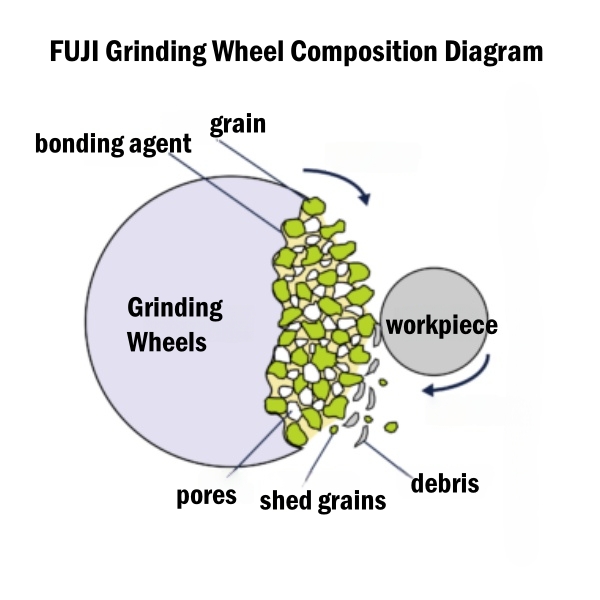
Illustration of grinding wheel structure: Abrasive grains, bond, and pores
The Anatomy: Abrasive (Teeth), Bond (Muscle), and Pores (Lungs).

1. The Anatomy of a Grinding Wheel

To select the right tool, you must understand what it is made of. Every grinding wheel is composed of three critical elements:

  1. Abrasive (The Teeth): These are the hard grains that do the actual cutting. Common materials include Alumina (for general steel) and Zirconia (for stainless steel and heavy-duty applications).
  2. Bond (The Muscle): This is the agent that holds the abrasive grains together. In angle grinding, this is typically a Phenolic Resin.
  3. Pores (The Lungs): These represent the empty spaces between grains. Pores allow for chip clearance and cooling air flow, preventing the wheel from overheating.

The Fuji Difference: Heat Treatment vs. Cold Pressing

Not all wheels are created equal. Many standard wheels on the market are produced using a fast "cold press" method.

At Fuji Grinding Wheel, we utilize a specialized Japanese heat-treatment technology. We use high-quality phenolic resin to bond acid-washed abrasives (such as Alumina and Zirconia) with a robust non-alkali fiberglass mesh.

  • Why Acid-Washing Matters: By acid-washing the abrasives, we remove surface impurities. This ensures a significantly stronger chemical bond between the grain and the resin.
  • The Result: A wheel with superior "self-sharpening" capabilities. As the grains dull, the bond releases them at the exact right moment to expose fresh, sharp edges. This prevents glazing and burning.

2. Classification: Understanding Bond Types

While there are many ways to classify wheels (by shape, size, or grit), the most distinct categorization for safety and application is by the bonding agent:

  • Vitrified (Ceramic) Bond: Extremely rigid and porous. Used for precision stationary grinding but is brittle and sensitive to shock.
  • Rubber Bond: Used for very fine finishing or wet cut-off operations where a smooth finish is prioritized over stock removal.
  • Resinoid Bond (The Fuji Standard): Made from phenolic resins. These wheels have high elasticity and strength, making them ideal for rough grinding, cutting-off, and heavy-duty fabrication. They can withstand higher operating speeds and mechanical shock, which is why they are the global standard for handheld angle grinders.

3. The "Dressing" Debate: A Fuji Safety Advisory

If you search for "how to fix a dull grinding wheel," you will find countless articles about a process called "Dressing." Dressing is the process of removing the top layer of a wheel to clear clogged material (loading) and expose new, sharp abrasive grains.

The Conventional Wisdom: For expensive, super-abrasive wheels (like Diamond or CBN) or large ceramic industrial wheels, dressing is mandatory. It extends the life of a tool that costs hundreds of dollars.

⚠️ The Fuji Stance: Why You Should NOT Dress Resin Wheels

For standard 6mm or 7mm resin-bonded grinding discs used in metal fabrication, Fuji Grinding Wheel strongly advises against dressing. Here is why:

  • Safety Hazards (Fiberglass Damage): Resin wheels are reinforced with internal fiberglass mesh to prevent shattering. Dressing requires aggressive force that can damage this reinforcement. A compromised mesh can lead to the wheel bursting at high RPMs.
  • Technical Difficulty: Proper dressing requires diamond-tipped tools and precise angles. Attempting this with makeshift tools in a standard workshop creates unnecessary risk.
  • Economics: Standard resin discs are cost-effective consumables. The risk of injury far outweighs the cost of simply grabbing a new, safe Fuji wheel.
Safety comparison: Replacing a worn wheel vs dangerous dressing
Safety First: Don't risk structural integrity by dressing resin wheels. Replace them.

4. Selecting the Best Wheel for the Job

Choosing the correct wheel is not just about size; it is about matching the abrasive to the material.

For Carbon Steel

Use Aluminum Oxide (Alumina). It is tough and resists fracturing, making it ideal for general-purpose steel grinding.

For Stainless Steel

Stainless steel is harder and generates more heat. Standard wheels can cause "blueing" (heat discoloration).

  • Good: Eco Flex or Green Star series (Specialized Alumina).
  • Best: Super W or JITAN Series. These use Zirconia Alumina, which is self-sharpening and cuts cooler to prevent discoloration.

Grit Size Selection

  • 24-36 Grit: Heavy stock removal (weld leveling, beveling).
  • 60-80 Grit: Finishing and blending surfaces.

5. Safety Standards and Best Practices

Compliance is non-negotiable. Whether following EN (Europe), ANSI (USA), or ISO standards, the physical integrity of the wheel is paramount.

Fuji Grinding Wheel label showing safety ratings and expiration date
Check the Label: Always verify RPM ratings and Expiration Dates.

3 Common Causes of Failure

  1. Speed Rating Mismatch: Never mount a wheel rated for 8,500 RPM on a grinder that spins at 11,000 RPM.
  2. Moisture Damage: Resin bonds degrade if stored in damp conditions. Always check the expiration date on the metal ring.
  3. Ignoring Inspection: Visually inspect for cracks or chips before every use.

Frequently Asked Questions (FAQ)

Q: Why does Fuji advise against dressing a resin-bonded grinding wheel?

A: Dressing standard resin wheels on angle grinders creates safety hazards. The process can damage the internal fiberglass reinforcement. At high RPMs, a compromised wheel can burst. For cost-effective consumables, replacement is safer and more economical.

Q: What is the benefit of Fuji's "Acid-Washed" abrasives?

A: Acid-washing removes surface impurities from the grain, creating a cleaner surface. This allows for a much stronger chemical bond with the resin. The result is a wheel that is more durable and self-sharpens more effectively, preventing glazing.

Q: How do I choose the right wheel for Stainless Steel?

A: Avoid standard Alumina wheels as they generate too much heat. Use Zirconia Alumina wheels like the JITAN Series or Super W. They cut cooler and prevent "blueing" discoloration on the workpiece.

Q: What is the "Ring Test"?

A: It is a method to check for cracks in vitrified wheels by tapping them gently to hear a clear ring. Note: This is less effective for resin wheels, where visual inspection is the primary safety check.

Ready to upgrade your fabrication process?

Stop struggling with dull, cold-pressed wheels. Experience the difference of Japanese engineered abrasives.

Contact Our Technical Team
Worker using a FUJI Series grinding wheel on stainless steel
Previous
Ultimate Grinding Wheel Selection Guide | FUJI Abrasives
Read More
FUJI KOSOKU High Frequency Angle Grinder HGC-902
Next
Three Power Sources for Industrial Grinding: Which Fits Your Heavy-Duty Needs?
Read More