


Japanese Quality. Affordable Heavy-Duty Grinding.
Weld grinding, deburring and heavy stock removal in shipyards, steel fabrication shops and industrial maintenance.
Size: 7 inch / 180*6/7mm(Thickness);Type 27 depressed center
Grit & grade options: 36P / 24S; custom options available
Packing: 25 pieces per inner box / 50 pieces per carton


Japanese Quality. Affordable Performance for Demanding Metal Grinding.
This 7-inch (180mm) grinding wheel from FUJI’s Super F2 series combines a Type 27 depressed center design with aluminum oxide abrasive for general steel and cast iron grinding. Designed for compatible 7-inch angle grinders, it is a practical choice for weld grinding, deburring, edge preparation and heavy stock removal in fabrication shops, shipyards and industrial maintenance operations.
Selected aluminum oxide abrasive, phenolic resin and alkali-free fiberglass reinforcement are combined using FUJI’s Japanese warm-press manufacturing process. Controlled material preparation, forming and curing support consistent wheel quality and dependable everyday performance. Manufactured in FUJI’s own factory under Japanese quality management standards, this wheel offers an affordable solution for workshops that need reliable abrasive supply for regular steel grinding.
Choose 6mm or 7mm thickness and a grade suited to the workpiece and grinding conditions. The commonly used Japanese 36P grade provides a balanced grinding feel, while 24S offers a coarser, harder option for more aggressive work. Custom grit, hardness and formulation are available when standard specifications do not fully match the application.

Aluminum oxide abrasive provides a practical balance of grinding performance and purchase cost for carbon steel, general steel and suitable cast iron applications. Select the grade to match your workload rather than paying for a specialized abrasive where it is not needed.
FUJI’s warm-press process combines abrasive grains and phenolic resin under controlled manufacturing conditions. Together with subsequent curing, this process supports bond consistency, structural integrity and stable product quality.
Alkali-free fiberglass mesh reinforces the resin-bonded wheel. This construction supports the wheel during its intended grinding operation, with correct selection and use remaining essential to safe performance.
Production in FUJI’s own factory provides direct control over materials, manufacturing and inspection. Japanese quality management standards support consistency for repeat industrial orders and application-specific development.
| Dimensions & Shape | 180mm diameter; 6mm or 7mm thickness; standard 22mm bore. Type 27 depressed center. Confirm the complete dimensions for the selected specification. |
|---|---|
| Abrasive & Construction | Aluminum oxide abrasive, phenolic resin bond and alkali-free fiberglass reinforcement; warm-press manufacturing. |
| Grit & Hardness | 36P or 24S. Custom grit, hardness and formulation available. |
| Operating Speed | Standard 72m/s; separately rated 80m/s specifications available on request. Follow the maximum operating RPM marked on the supplied wheel. |
| Packaging | 25 pieces per inner box / 50 pieces per carton. Confirm packaging for custom specifications when ordering. |
Both 6mm and 7mm thicknesses are available. Select the thickness together with the wheel grade, grinder capacity and access around the workpiece. A thicker wheel contains more abrasive material, but service life and removal rate also depend on the formulation, applied pressure and grinding conditions.
Grit 36 with grade P hardness is a commonly used Japanese specification. Compared with 24S, it uses a finer abrasive and a softer bond grade, making it a useful starting point when grinding feel and control are priorities.
Grit 24 with grade S hardness provides a coarser, harder specification for more aggressive material removal. It may produce a rougher grinding feel and greater vibration, depending on the machine, workpiece and operator pressure.
Custom options: FUJI can adjust grit, hardness, formulation and dimensions to suit your material and production conditions. Share your current wheel, equipment and the improvement required so that a suitable trial specification can be proposed.
The 180mm wheel suits jobs where a compatible 7-inch grinder is preferred for sustained material removal over larger working areas. Typical applications include:
For demanding foundry casting applications where a zirconia abrasive is preferred, consider the 180mm FUJI Super Z grinding wheel for heavy-duty castings . Select between Super F2 and Super Z according to the casting material, grinding workload and the cost per completed part.

For foundries and industrial facilities equipped with a suitable high-frequency power supply, the FUJI 300Hz high-frequency angle grinder for foundry castings is an option for sustained heavy grinding. Its industrial drive is designed to support stable performance under working load, helping maintain productive grinding when the machine and abrasive are correctly matched.
Choose a compatible 80m/s-rated 180mm Super F2 wheel for general steel grinding, or assess Super Z for demanding casting applications. Evaluate the complete combination using material removed per minute, grinding time per part and wheel consumption. Actual productivity gains depend on the casting, wheel grade, equipment and operating conditions.
The HGC-3902 model is specified at 8,400rpm and requires a compatible 80m/s-rated wheel with a marked maximum RPM suitable for that machine. Do not use the standard 72m/s version with this model. Confirm the bore, flanges, guard and permitted wheel dimensions before use. The grinder requires a compatible three-phase 200V, 300Hz supply; it cannot be connected directly to ordinary 50Hz or 60Hz mains power.
The supplied MonotaRO review screenshot shows an average rating of 4.69 out of 5 from 39 reviews for the Super F2 series. Customer comments include practical use in weld preparation and general steel grinding, along with observations about value and specification availability.
These are third-party reviews covering products within the Super F2 series, not a separate rating verified exclusively for this 180mm specification. The figures reflect the supplied screenshot and may differ from the current retailer listing.
Test both grades on the same material using the same grinder and comparable operating conditions. Record grinding time, wheel consumption, finished surface and operator feedback. 24S is coarser and harder, but the better production choice is the grade that delivers the required result at an acceptable cost per part.
Provide the steel grade, weld condition, grinder model and speed, required dimensions, and current wheel specification. Explain whether your priority is removal rate, service life, grinding comfort or surface finish. These details help FUJI select between standard grades or propose a modified formulation.
Super F2 is an affordable aluminum oxide option for general steel and suitable cast iron grinding. Consider Super Z zirconia grinding wheels when evaluating more demanding casting cleanup or sustained stock removal. A production trial should determine whether the change reduces grinding time or abrasive cost per casting.
No. Order the separately rated 80m/s specification and check the maximum RPM marked on the supplied wheel against the grinder’s rated speed. A custom speed specification is a different supplied wheel rating, not permission to run a 72m/s wheel faster.
Use a formulation selected for aluminum rather than assuming this general steel grinding wheel is suitable. FUJI offers a 125mm aluminum grinding wheel for aluminum fabrication. Provide the alloy and application requirements when discussing other dimensions or custom options.
Confirm wheel dimensions, mounting compatibility and marked maximum speed before use. Follow the wheel instructions and grinder manual, and use the correct guard and protective equipment. Request applicable safety documentation for the exact specification supplied.
Match the abrasive and equipment to your material, working area and production requirements. Alongside this 180mm Super F2 grinding wheel, FUJI offers the following options for grinding, cutting and finishing.
Since 1953, FUJI has specialized in grinding wheels, cutting discs and industrial grinding equipment. With more than 70 years of abrasive experience, FUJI serves metalworking applications ranging from everyday steel fabrication and maintenance to demanding shipyard and foundry grinding.
FUJI combines Japanese quality management standards with production in its own factory, maintaining direct control over materials, manufacturing and inspection. ISO 9001 quality management supports consistent production, while application-specific development allows wheel formulations and dimensions to be adapted to customer requirements. The focus is practical performance, dependable quality and product safety.
Learn more about FUJI’s company history and our quality management and certificates .
Looking for a dependable supply of 180mm grinding wheels for steel fabrication, shipyard maintenance or casting cleanup? FUJI can help you select a standard Super F2 specification or assess an alternative for your production conditions.
For application-specific requirements: Share your workpiece material, grinder model, current grinding wheel, monthly consumption and the issue you want to improve. This helps us assess a suitable formulation or trial specification.
Choosing the correct abrasive wheel is critical for both operational efficiency and JIS-compliant safety. Fuji Grinding Wheels are engineered with precise technical markings to ensure the perfect match for your specific material and machine requirements.
For professional export markets, always verify the Peripheral Speed (m/s) compatibility. Fuji wheels are designed to exceed JIS Burst Speed factors, but operating at the recommended R.P.M. ensures the longest tool life and cleanest cut.
Note: Mismatched grit or hardness can lead to excessive heat buildup, affecting the workpiece's structural integrity.
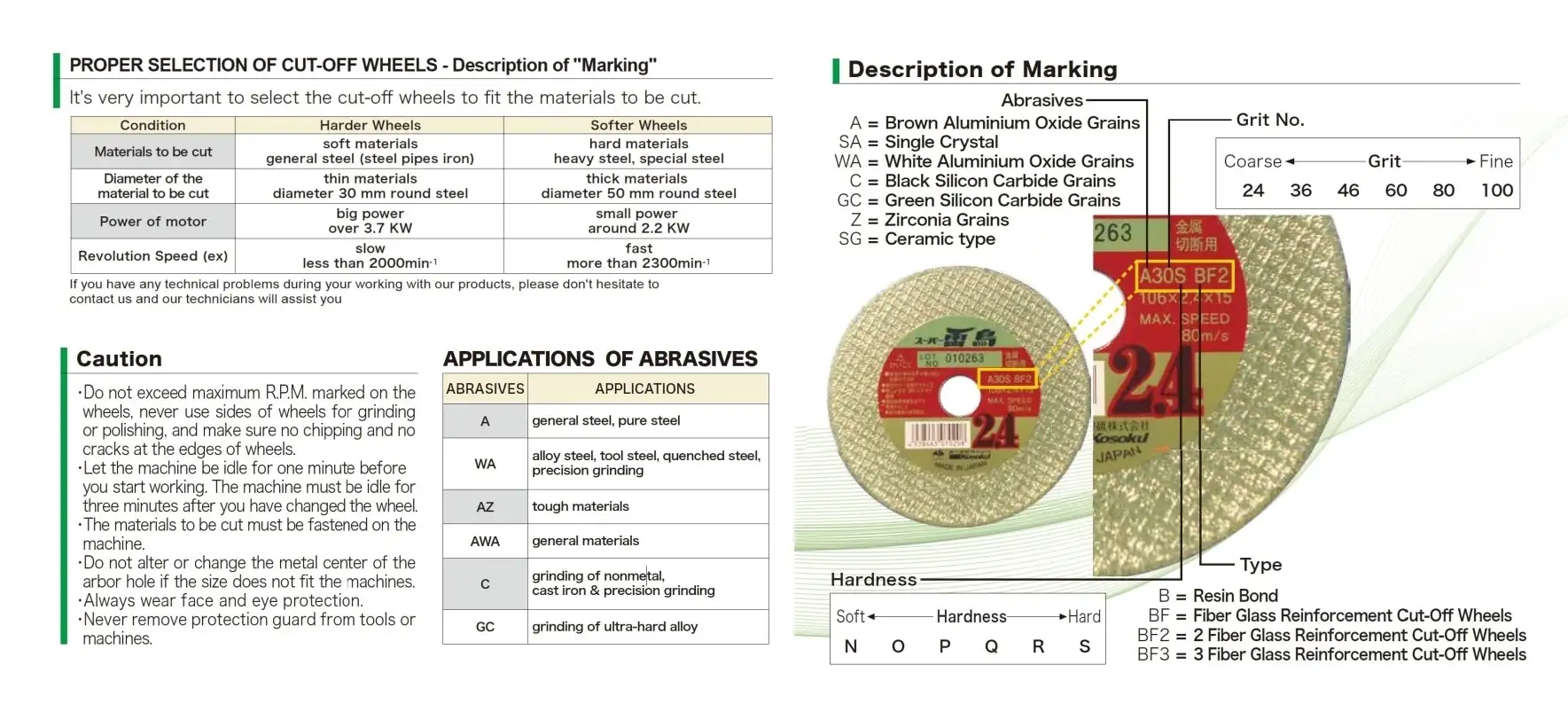
Global Maintenance Standard: To maintain the high safety factor of Fuji wheels, avoid exposure to excessive humidity and chemical solvents during storage. Proper care preserves the resinoid bond's strength, crucial for high-load industrial applications.
Fuji products are manufactured following strict Japanese standard process requirements. Every wheel is engineered to meet or exceed JIS (Japanese Industrial Standards), such as JIS R 6242 and B 4051. Our core engineering logic prioritizes maximum operator protection by maintaining safety factors and burst speed capabilities that often surpass the highest industry benchmarks.
| Standard Region | Safety Factor (Burst Multiplier) | Safety Logic & Benchmark |
|---|---|---|
| FUJI (High Precision) | > 2.0x | Engineered to exceed JIS requirements for maximum reliability. |
| Japan (JIS R 6242) | 2.0x | Extreme Safety: A wheel rated at 80m/s must withstand a 160m/s burst test. |
| Europe (EN 12413) | 1.73x | Risk Balanced: Provides high safety redundancy for most industrial apps. |
| USA (ANSI B7.1) | 1.5x | Efficiency Focused: Relies on machine guarding and operational procedures. |
Abrasive Selection Guide
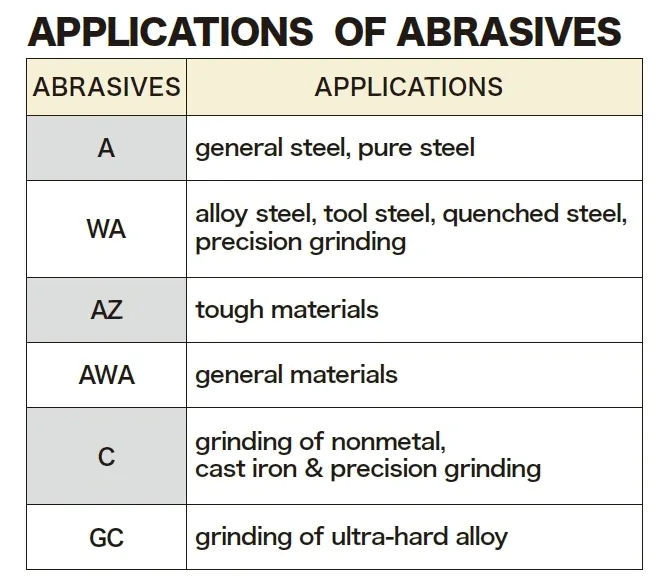
Selection of grains (A, WA, AZ, etc.) based on material hardness and grinding precision.
Warning Symbol Interpretation
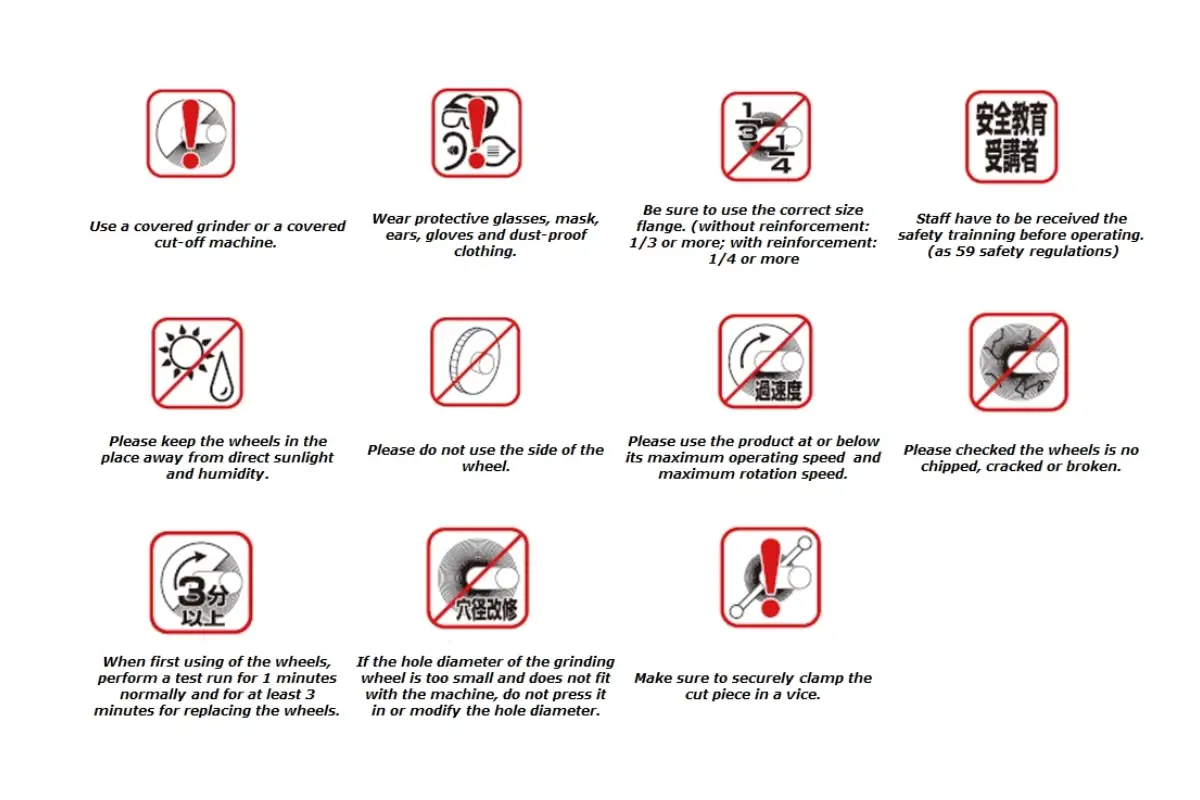
Standardized safety icons for safe operation and protection guard usage.
When deploying Fuji high-performance tools in overseas markets, ensure that the regional power grid frequency and voltage match the tool specifications. To maintain the superior burst speed safety of Fuji wheels, store abrasives in a dry, temperate environment. Humidity can degrade the resin bond, potentially lowering the wheel’s resistance to centrifugal forces.
Fuji products are manufactured following strict Japanese standard process requirements. Every wheel is engineered to meet or exceed JIS (Japanese Industrial Standards), such as JIS R 6242 and B 4051. Our core engineering logic prioritizes maximum operator protection by maintaining safety factors and burst speed capabilities that often surpass the highest industry benchmarks.
| Standard Region | Safety Factor (Burst Multiplier) | Safety Logic & Benchmark |
|---|---|---|
| FUJI (High Precision) | > 2.0x | Engineered to exceed JIS requirements for maximum reliability. |
| Japan (JIS R 6242) | 2.0x | Extreme Safety: A wheel rated at 80m/s must withstand a 160m/s burst test. |
| Europe (EN 12413) | 1.73x | Risk Balanced: Provides high safety redundancy for most industrial apps. |
| USA (ANSI B7.1) | 1.5x | Efficiency Focused: Relies on machine guarding and operational procedures. |
Abrasive Selection Guide
Selection of grains (A, WA, AZ, etc.) based on material hardness and grinding precision.
Warning Symbol Interpretation
Standardized safety icons for safe operation and protection guard usage.
When deploying Fuji high-performance tools in overseas markets, ensure that the regional power grid frequency and voltage match the tool specifications. To maintain the superior burst speed safety of Fuji wheels, store abrasives in a dry, temperate environment. Humidity can degrade the resin bond, potentially lowering the wheel’s resistance to centrifugal forces.


