When weld cleanup or repeated stock removal takes too long, changing the abrasive can be as important as changing the grinder. FUJI JITAN is a premium Japanese-made grinding wheel developed for efficient metal removal with controlled handling. Its name means time saving.
This application study combines FUJI-reported factory test results for 105 × 6 mm wheels on SS400 steel and SUS304 stainless steel with practical guidance for selecting compact 105 mm and 125 mm wheels. The factory comparisons are separate from the application examples below; they are not evidence of a guaranteed result at every customer site.
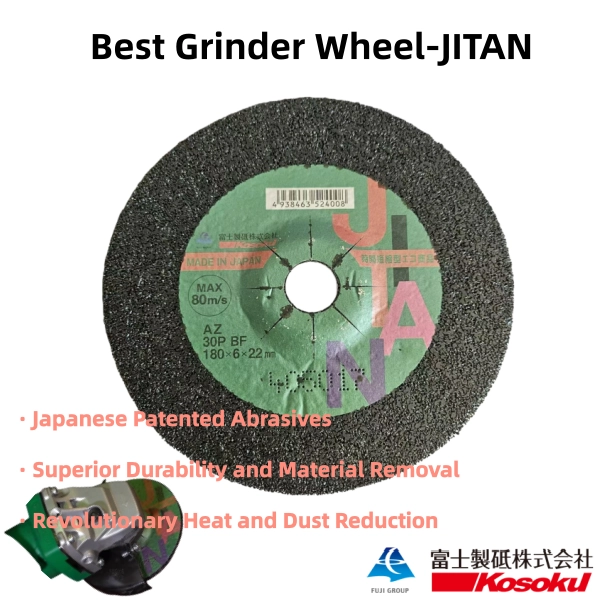
FUJI supplied the following results from its 20-minute comparison tests. The comparison wheels were another company’s 105 × 6 mm zirconia wheels. Values below distinguish workpiece material removed from wheel mass lost; lower wheel wear alone is not the same as higher productivity.
| Workpiece | Wheel | Material removed | Wheel wear |
|---|---|---|---|
| SS400 steel | FUJI JITAN 105 × 6 mm | 1,235 g | 50 g |
| SS400 steel | Comparison zirconia wheel, 105 × 6 mm | 540 g | 69 g |
| SUS304 stainless steel | FUJI JITAN 105 × 6 mm | 531 g | 49 g |
| SUS304 stainless steel | Comparison zirconia wheel, 105 × 6 mm | 403 g | 68 g |
SS400: JITAN removed approximately 2.29 times as much steel, with approximately 28% less wheel mass loss in the reported comparison.
SUS304: JITAN removed approximately 32% more stainless steel, with approximately 28% less wheel mass loss.
These percentages are calculated from the reported values. They do not establish three times the service life, a fixed reduction in dust or heat, or an equivalent increase in a workshop’s finished output. The full protocol—including grinder model, speed, applied load, repeat count and variation—is not provided here. Treat the figures as manufacturer-reported comparison results and arrange a representative trial before estimating savings.
A useful additional measure is material removed per gram of wheel mass lost: approximately 24.7 versus 7.83 g/g on SS400, and 10.84 versus 5.93 g/g on SUS304. This is a mass-based consumption measure, not a volume-based grinding ratio or a guaranteed cost saving.
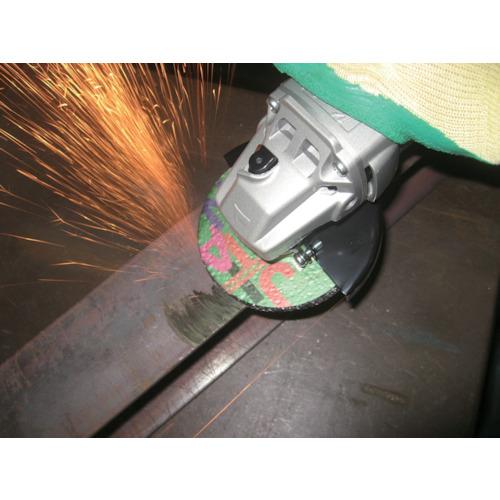
FUJI JITAN grinding wheels use selected zirconia-alumina abrasive, phenolic resin and a layered construction produced in Japan. FUJI’s warm-press and lamination processes are intended to distribute the abrasive and bond consistently and support responsive grinding.
The P wheel grade describes how firmly the bond retains abrasive grains; it is not the hardness grade of the zirconia mineral. Product construction, wheel grade and the way fresh cutting points become available work together with the machine and operating load.
JITAN is designed to support effective removal without relying on excessive operator force. However, handling, heat and vibration depend on the complete setup. Do not press harder to compensate for a damaged, unsuitable or poorly cutting wheel. No manufacturing process makes an abrasive immune to misuse, and no wheel guarantees a burn-free workpiece or safe dust and vibration exposure.
| Selection | Application to evaluate | Important limit |
|---|---|---|
| 105 mm diameter | Compact tools and local grinding on accessible welds, brackets and smaller components. | Verify the permitted diameter, bore, flanges, guard and maximum speed. |
| 125 mm diameter | Compact fabrication work where a compatible 125 mm grinder and the available access suit the task. | The 105 mm test results must not be presented as measured 125 mm performance. |
| 3 mm thickness | Light grinding and thin stainless sheet where controlling heat and removal allowance is important. | Test for distortion and local thinning; this does not make the wheel a cutting disc. |
| 4 mm thickness | An additional specification to discuss for the required task and handling preference. | Confirm the available diameter, grade and thickness combination with FUJI. |
| 6 mm thickness | General industrial grinding and repeated stock removal where wear resistance matters. | The reported factory results apply to 105 × 6 mm wheels only. |
For applications needing 6-inch or 7-inch wheels, ask FUJI about production options and the exact specification. This guide focuses on compact 105 mm and 125 mm grinding.
For SS400 steel brackets, frames and fabricated components, define the finished weld profile or edge requirement before grinding. Select a wheel that removes the unwanted material while allowing controlled positioning. A high removal rate has little value if it creates undercut, removes required weld metal or adds later rework.
Use the SS400 factory result as a starting point for a workshop trial, not a prediction of cycle time. Compare the same component, weld condition and acceptance standard. Record the time to an acceptable part, wheel consumption and any subsequent blending required.
The SUS304 comparison makes JITAN relevant to stainless fabrication where both removal and wheel consumption matter. For thin panels and tube assemblies, keep attention on the remaining wall thickness, local temperature and appearance. FUJI recommends evaluating the 3 mm option for thin-sheet grinding and the 6 mm option for general work, subject to the actual component and machine.
Use abrasives reserved for stainless steel and protect the work from carbon-steel dust and handling contamination. Inspect between passes. Do not assume that a wheel which cuts efficiently eliminates heat tint, distortion or the need for post-fabrication cleanup. See the stainless steel weld grinding and finishing guide for the broader workflow.
On batches of small metal parts, the useful question is whether JITAN helps produce more accepted components with manageable wheel changes and finishing time. Evaluate accessible burrs, weld transitions and surface irregularities under consistent conditions.
For cast iron, other alloys or unusually hard materials, confirm the abrasive specification and conduct a separate trial. The SS400 and SUS304 results do not demonstrate performance on every metal. A grinding wheel also does not replace the flap disc or other finishing abrasive needed for a specified final surface.
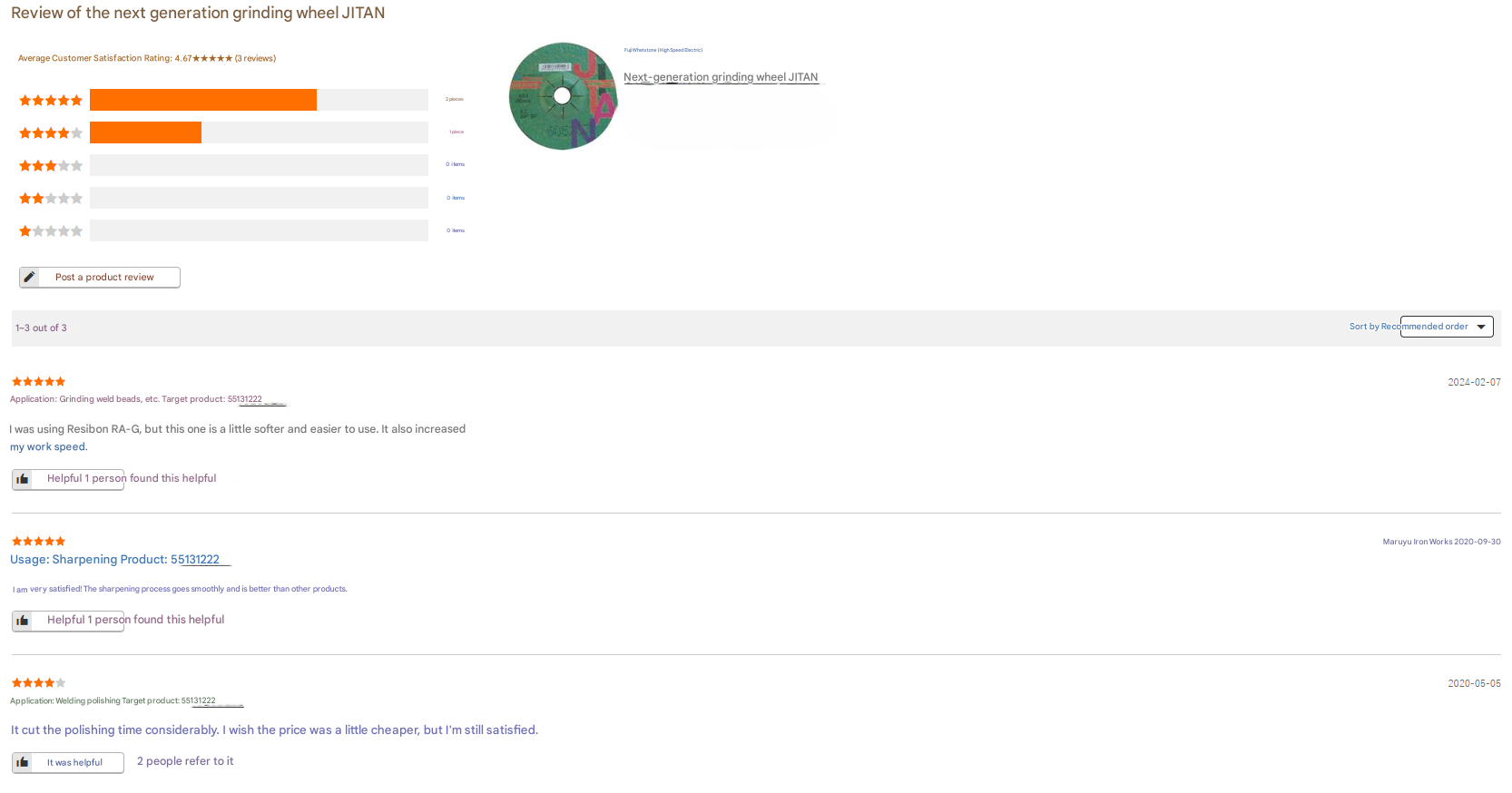
Original JITAN reference illustration. The numerical comparison above is attributed to FUJI’s factory test, not to named customer endorsements.
Keep the tool, material and work acceptance criteria consistent when comparing wheels. Inspect and mount each abrasive according to the tool and wheel instructions. The wheel’s maximum RPM must be at least the machine’s rated maximum speed; a matching diameter alone does not prove compatibility.
A shorter grinding time can contribute to savings, but the total benefit depends on the production process. Manage dust, vibration exposure and protective measures through the workplace assessment; the test data on this page do not measure those hazards.

Yes. JITAN is FUJI’s premium Japanese-made grinding wheel. Consult the product page and supplied documentation for the selected specification.
The reported tests show higher material removal and lower wheel mass loss under those test conditions. They do not establish a universal threefold service life. Use a controlled trial to compare usable output and cost on your workpieces.
They provide context for the product family, but the measured values are for 105 × 6 mm wheels. Confirm the 125 mm specification and assess it on the intended grinder and task.
It is an option to evaluate for thin-sheet grinding, but results depend on pressure, contact time, support and removal allowance. No wheel guarantees zero heat damage.
JITAN is a grinding wheel. Whether an additional blending or polishing stage is necessary depends on the required finish. Confirm available grit specifications rather than assuming an unverified #30–#120 range.
Provide the material grade, workpiece photographs, weld or burr dimensions, permitted removal, grinder specification and required finish. FUJI can recommend a wheel specification and discuss evaluation arrangements. Review the JITAN product specifications or browse FUJI grinding and finishing abrasives.


