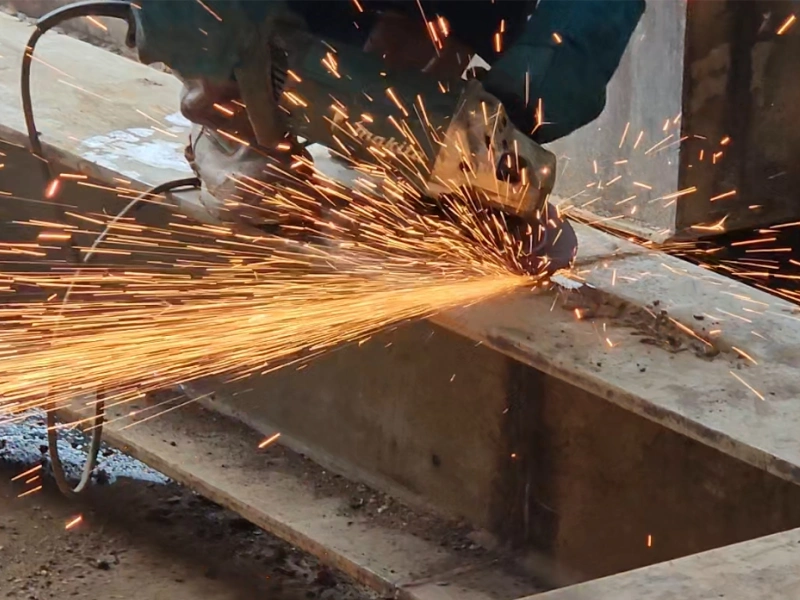
 Heavy industrial environments demand abrasives that balance aggressive material removal with uncompromising operator safety.
Metal grinding remains a foundational process across global heavy industries, from aerospace fabrication and automotive assembly to shipbuilding and foundry operations. The process — which removes excess material via bonded abrasive grains rotating at high speed — must continuously balance three critical priorities: operational efficiency, metallurgical workpiece quality, and worker occupational safety, all while meeting tightening environmental and compliance regulations.
Despite advances in automated machining, manual angle grinding accounts for over 60% of on-site metal finishing work. For these operations, low-quality uncertified grinding wheels create cascading costs: faster wheel consumption, longer production downtime, thermal damage to high-value workpieces, and elevated risk of catastrophic wheel failure. This guide breaks down how premium Japanese-engineered abrasives solve these pain points, and how to select the right wheel for your specific industrial application.
Founded in 1953, FUJI Grinding Wheel (KOSOKU) has grown from a specialized abrasive workshop into Japan’s leading end-to-end industrial metalworking solution provider. Our seven-decade legacy is built on relentless metallurgical R&D, zero-defect quality control systems, and an unwavering commitment to putting operator safety at the center of every product design.
What makes FUJI uniquely positioned in the global market is our one-of-a-kind dual-manufacturing capability. We are the only Japanese manufacturer that designs and produces both heavy-duty industrial power tools — including industry-leading 250Hz and 300Hz high-frequency grinders — and the premium abrasive wheels engineered to run on them. This holistic understanding of grinding dynamics ensures perfect mechanical synergy between tool and consumable.

Procurement teams face constant pressure to reduce consumable costs without sacrificing safety or output. FUJI eliminates this tradeoff by delivering lower total cost of ownership over the full product lifecycle. Shipyards, foundries, and metal fabricators across 20+ countries partner with us for four core reasons:
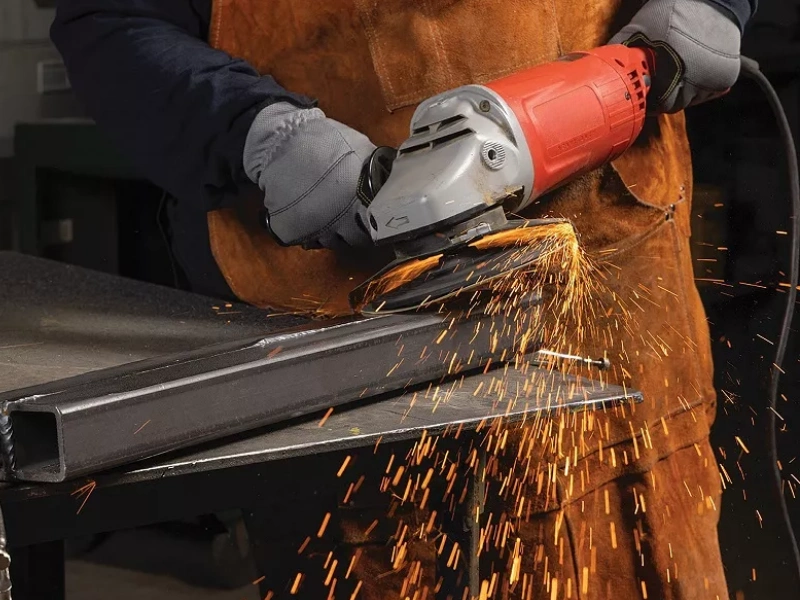
Because we engineer both the power tools and the abrasives, we calibrate every wheel formula to match the exact torque, RPM, and vibration profile of FUJI grinders. This eliminates motor bogging, maximizes material removal rates, and extends both tool and wheel service life.
Every production batch undergoes rotational burst testing, impact resistance verification, and dynamic balance calibration. All products meet or exceed JIS (Japanese Industrial Standards) and ISO 9001 requirements, with safety factors that outperform European and North American benchmarks.
Our in-house metallurgical team continuously innovates resin bond matrices and abrasive grain blends. We develop dedicated formulas for specific materials — from hardened alloy steel and cast iron to heat-sensitive stainless steel — rather than relying on generic one-size-fits-all formulations.
Through our exclusive strategic partner Pio-Ship System Co., Ltd., we maintain regional offices across Europe, Southeast Asia, and North America. This ensures reliable delivery, local technical consultation, and responsive after-sales support for industrial clients worldwide.
In conventional cold-press manufacturing, abrasive grains and resin binders are pressed into shape at room temperature and cured in an oven in a separate step. This two-stage process leaves microscopic air voids scattered throughout the wheel structure. These voids cause uneven wear, premature grain shedding, and structural weakness under high-RPM and high-load conditions.
FUJI’s hot-press technology cures premium Sumitomo phenolic resin and selected abrasive grains under simultaneous high temperature and extreme mechanical pressure. This fuses the bond matrix into a near-porous-free, uniformly dense structure. The result is a perfectly balanced wheel that withstands the extreme forces of heavy-duty grinding, resists cracking, and delivers up to 30% longer service life than cold-pressed alternatives.
| Performance Metric | FUJI Hot-Pressed Wheels | Standard Cold-Pressed Wheels |
|---|---|---|
| Internal Porosity | Near-zero uniform pore structure | High, uneven microscopic voids |
| Burst Safety Factor | Over 2.0x rated speed (exceeds JIS) | 1.5–1.7x rated speed (minimum compliance) |
| Relative Service Life | 130% (30% longer lifespan) | 100% (industry baseline) |
| Workpiece Heat Buildup | Low (controlled via breathing pores) | High (prone to glazing and burning) |
| Vibration Level | Low (precision balanced) | High (uneven density distribution) |
Rapid wheel dulling and glazing are the most persistent productivity bottlenecks in grinding operations. When abrasive grains become blunt, material removal rates drop sharply while grinding forces and heat generation rise exponentially. This forces frequent wheel dressing or replacement, creating costly unplanned downtime.
FUJI solves this with advanced self-sharpening grain technology — most notably in our premium JITAN zirconia series. As grain tips dull under load, they micro-fracture cleanly along crystalline planes to expose fresh, sharp cutting edges. Combined with our hot-pressed bond matrix, this maintains consistent cutting performance from the first use until the wheel is fully consumed.
Excessive friction heat during heavy stock removal causes surface burns, micro-cracking, and residual stress that permanently compromise workpiece structural integrity. In aerospace, pharmaceutical, and food-grade stainless steel applications, thermal discoloration or work hardening can render expensive components completely unusable.
FUJI’s Green Star and JITAN series address this with engineered “breathing” pore structures that dissipate heat rapidly at the grinding interface. In controlled testing on 304 stainless steel, FUJI JITAN wheels limited workpiece temperature rise to approximately 50°C after one minute of continuous grinding, compared to nearly 100°C with standard competitor wheels — eliminating thermal discoloration and post-grinding rework.
Beyond the catastrophic risk of wheel burst from low-quality uncertified abrasives, prolonged grinding exposes workers to chronic ergonomic hazards. Excessive vibration from unbalanced wheels accelerates fatigue and significantly increases risk of Hand-Arm Vibration Syndrome (HAVS, also known as White Finger Disease). Excessive spark and dust generation also elevates fire and respiratory risks in confined spaces like ship hulls.
FUJI’s precision hot-press construction creates near-perfect wheel balance, drastically reducing transmitted vibration. Our advanced bond formulations also reduce airborne dust by up to 60% compared to cold-pressed wheels, improving workshop air quality and reducing long-term occupational health risks.
| Standard Region | Required Burst Safety Factor | Safety Framework Logic |
|---|---|---|
| FUJI (High Precision) | > 2.0x | Engineered to exceed JIS requirements for maximum reliability |
| Japan (JIS R 6242) | 2.0x | Extreme safety: 80m/s rated wheel must withstand 160m/s burst test |
| Europe (EN 12413) | 1.73x | Risk-balanced: High safety redundancy for most industrial applications |
| USA (ANSI B7.1) | 1.5x | Efficiency-focused: Relies on machine guarding and operational procedures |
Rather than marketing a single generic wheel for all uses, FUJI engineers dedicated abrasive formulations optimized for specific materials and operating conditions to minimize your total cost of ownership.
Formulated for foundry operations, structural steel fabrication, and heavy weld removal, the Super F2 prioritizes aggressive stock removal and extreme durability. Its rigid hot-pressed bond withstands high downward pressure, reducing wheel consumption rates significantly for high-volume production environments.
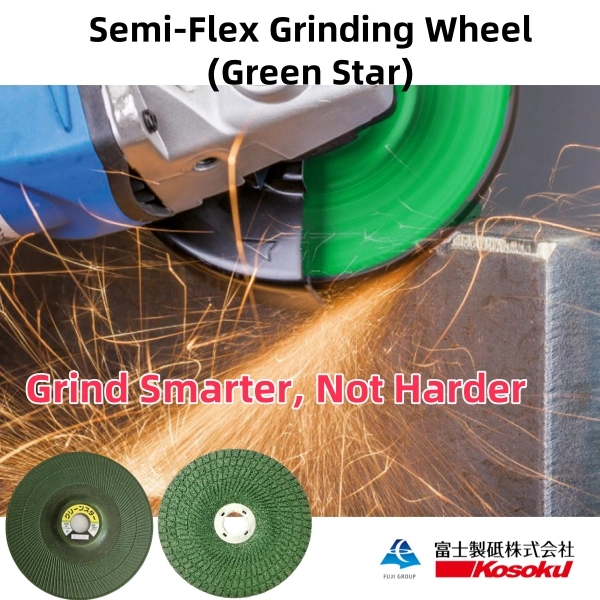
The semi-flexible Green Star series is engineered specifically to prevent thermal damage on heat-sensitive materials like 304/316 stainless steel and thin sheet metal. Its patterned cooling grooves and flexible edge adapt perfectly to curved and contoured surfaces, delivering smooth finishes without burning or discoloration.
Manufactured to Japan’s highest quality standards, the JITAN series uses patented zirconia alumina abrasive grains for industry-leading durability and cutting performance. It delivers consistent results across ferrous and non-ferrous metals, with low vibration, minimal sparking, and a finish quality so smooth it often eliminates secondary polishing steps.
Choosing the wrong wheel formula wastes consumable budget, damages workpieces and creates safety hazards. Use this guide to match FUJI abrasives to your specific workflow:
| Workpiece Material | Recommended FUJI Series | Recommended Grit | Common Applications |
|---|---|---|---|
| Carbon Steel / Mild Steel | Super F2 / JITAN | #24 – #36 | Structural welding, weld seam leveling, heavy stock removal |
| Stainless Steel (304/316) | Green Star / JITAN | #36 – #60 | Sanitary piping, food equipment fabrication, architectural metalwork |
| Cast Iron / Foundry Parts | Super F2 / JITAN | #24 – #36 | Gate removal, fettling, casting surface restoration |
| Alloy Steel / Hardened Steel | JITAN | #36 – #60 | Tool and die work, heavy machinery component finishing |
| Aluminum / Non-Ferrous Metals | JITAN / Green Star | #46 – #80 | Light fabrication, deburring, contour blending |
| Precision Finishing / Pre-Paint | Green Star / JITAN Fine | #80 – #120 | Surface conditioning, scratch removal, blend polishing |
For facilities using FUJI 250Hz/300Hz high-frequency grinders, we exclusively recommend JITAN series wheels. Standard cold-pressed wheels cannot withstand the constant high-RPM torque of HF tools and will fail rapidly. The dense hot-pressed structure of JITAN wheels maintains structural integrity at continuous high speeds, delivering 3–5x higher material removal rates compared to standard grinder setups.
Even the highest quality grinding wheel will underperform if stored or maintained incorrectly. Follow these industry-standard best practices to maximize wheel life and ensure safe operation:
| Problem | Most Likely Cause | Recommended Solution |
|---|---|---|
| Wheel glazing / slow cutting | Grit too fine for material, or bond too hard | Switch to coarser grit or softer bond grade; dress the wheel to expose fresh grains |
| Excessive wheel wear | Bond too soft for hard material, or excessive operator pressure | Switch to harder bond grade; reduce downward pressure to let the abrasive cut |
| Workpiece burning / discoloration | Glazed wheel, wrong abrasive type, or slow travel speed | Use Green Star or JITAN cool-cut wheels; maintain steady forward movement |
| Excessive vibration | Damaged wheel, worn spindle bearings, or unbalanced flange | Replace wheel immediately; inspect grinder spindle and flange hardware |
Transitioning to FUJI abrasives consistently delivers measurable, quantifiable ROI for industrial operations worldwide:
A: Substandard wheels typically use low-grade cold-press manufacturing and inconsistent recycled abrasive grains. This causes rapid wear, severe overheating, and dangerous structural failures during high-RPM operations, unlike JIS-certified hot-pressed wheels built for industrial duty.
A: Unlike standard cold-pressed wheels, FUJI's proprietary hot-press technology cures resin and abrasives under simultaneous extreme heat and pressure. This eliminates microscopic air voids, creating an extremely dense, perfectly balanced wheel that lasts 30% longer and withstands the heavy forces of 300Hz high-frequency grinding.
A: The Green Star series uses a unique semi-flexible structure combined with engineered cooling grooves and a heat-dissipating bond matrix. This allows the wheel to dissipate friction heat rapidly during operation, preventing metallurgical changes and discoloration on sensitive materials like 304/316 stainless steel.
A: While physically possible, it is highly discouraged. Using a wheel previously run on carbon steel can embed free iron particles into stainless steel surfaces, causing cross-contamination and premature rusting. We recommend dedicated wheels per material, or our versatile JITAN series formulated for multi-metal use.
A: We exclusively recommend our JITAN zirconia series for 250Hz and 300Hz high-frequency grinders. Standard cold-pressed wheels cannot withstand the continuous high RPM and constant torque of HF tools. The dense hot-pressed JITAN structure maintains integrity and delivers 3–5x higher material removal rates.
A: FUJI is the only manufacturer in Japan that produces both heavy-duty power tools and the grinding wheels themselves. This dual expertise creates perfect mechanical synergy. Combined with 70+ years of history, rigorous JIS/ISO quality control, and global distribution via Pio-Ship System Co., Ltd., FUJI delivers unmatched industrial reliability.
Stop compromising on safety, quality and efficiency. As a leading Japanese industrial grinding wheel manufacturer, FUJI can help you reduce total operational costs while improving workplace safety. Contact our team today to discuss your specific applications, request product samples, or get expert abrasive recommendations tailored to your production needs.


